
WhatsApp for sales teams
Selling on WhatsApp is not selling by email with a different app. The platform decides when you may contact someone, which changes how qualification and follow-up have to be built. This page covers the workflow, the constraint that shapes it, and where the inbox stops and your CRM starts.
- Inbound leads in one queue, each with an owner and a response target
- The 24 hour window rule, and what it means for a lead you did not close today
- Follow-up that is designed rather than improvised, using approved templates
- A clear boundary between the conversation and the CRM record
Short answer
A sales team on WhatsApp needs the same three things a support team needs, an owner, a clock and a history, plus one thing support does not: a follow-up plan that works within WhatsApp’s messaging window.
That constraint is the whole difference. A customer’s message opens a 24 hour window in which you can say anything. Once it closes, an approved template is the only way back in.
From first message to closed, or to a real follow-up
Five stages. The fourth is the one most teams get wrong on WhatsApp specifically.
- 01
The lead arrives and gets an owner
An inbound message opens a conversation with the contact attached. Automation routes it to the sales team, or a rep claims it. From then on it carries one owner.
No lead sits in a shared list that everyone assumes somebody else is handling.
- 02
Qualification happens in the thread
Tags and priority mark what kind of lead it is and how hot. Internal notes carry what the rep learned, including the things you would never put in a CRM field.
The next person to open it, including the rep tomorrow morning, reads the same context.
- 03
A response target keeps it honest
An SLA policy scoped to the sales team sets a first response target, so a lead that arrives at 4pm is measured rather than remembered.
Slow first responses show up as a number on the queue monitor, not as a feeling.
- 04
Follow-up is planned around the window
While the 24 hour window is open, reply normally. Once it closes, the only way back is an approved template, so the templates you will need must exist before the window shuts. Outbound campaigns cover the case where you are reaching a list rather than a person.
A lead that goes quiet gets a real follow-up instead of a rep discovering the rule at the worst moment.
- 05
Handoff and hand-back
Reassign to another rep or to the support team once the deal closes, with the thread and notes attached. Tasks and appointments carry the commitments that outlive the conversation.
The customer never has to explain the deal again to the person who now owns them.
The rule that shapes WhatsApp sales
A message from a customer opens a 24 hour customer service window. Inside it you can send any message type. Outside it, template messages are the only type that can be sent, and templates are created and approved in advance.
For sales, that means the classic "I will chase them next week" does not exist as an improvised message. It exists as a template you wrote before you needed it, or it does not happen.
Marketing templates also need the recipient to have opted in, and they are charged. So the cost of a follow-up is not only the message: it is the opt-in you collected and the rate for that country.
One useful exception: if a lead reaches you from a click-to-WhatsApp ad or a Page call-to-action button and you reply within 24 hours, a free entry point window opens for 72 hours and everything you send inside it is free. If you run ads into WhatsApp, replying fast is worth money and not just goodwill.
What a rep and a manager actually see
Real captures from a live marv.Inbox workspace.
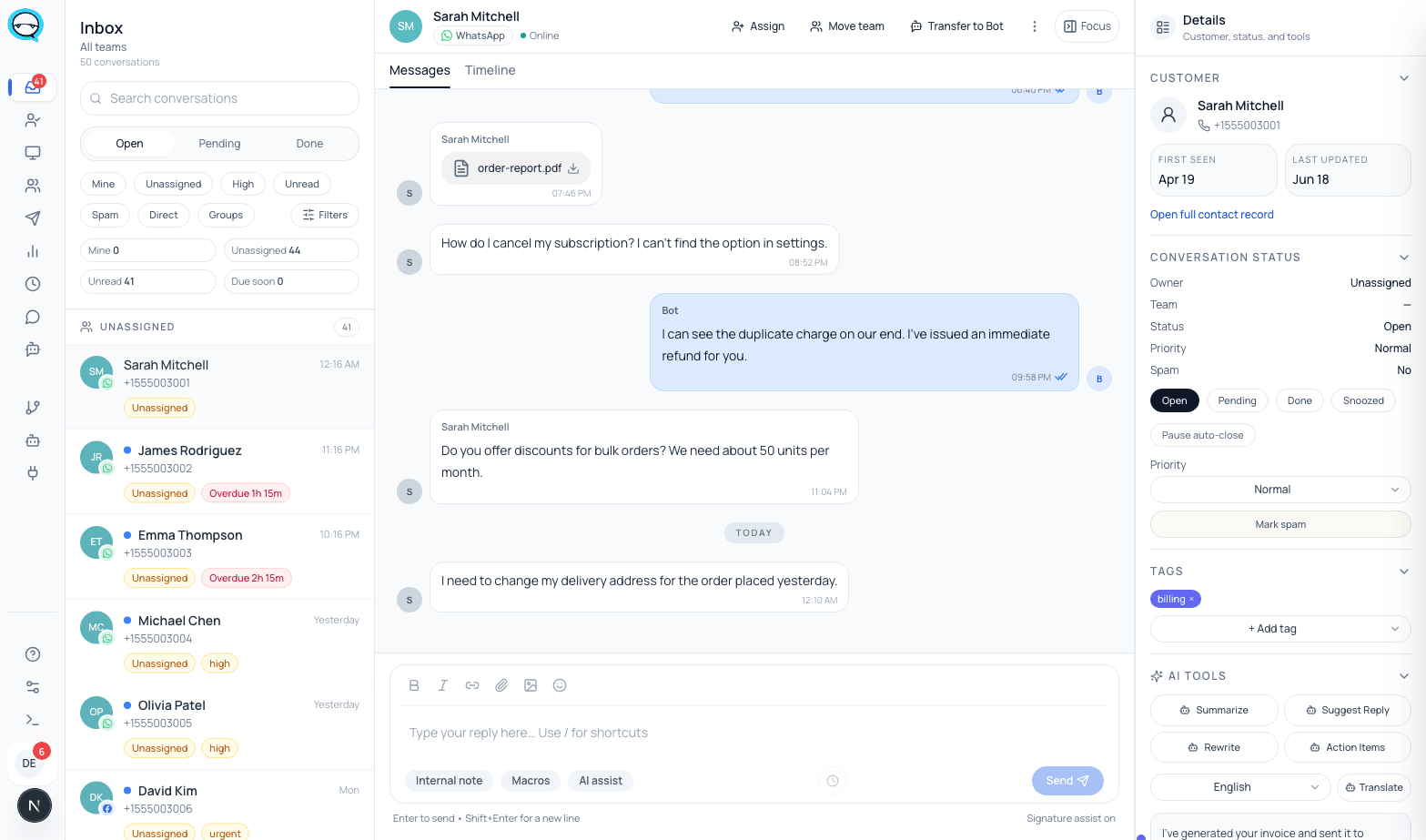
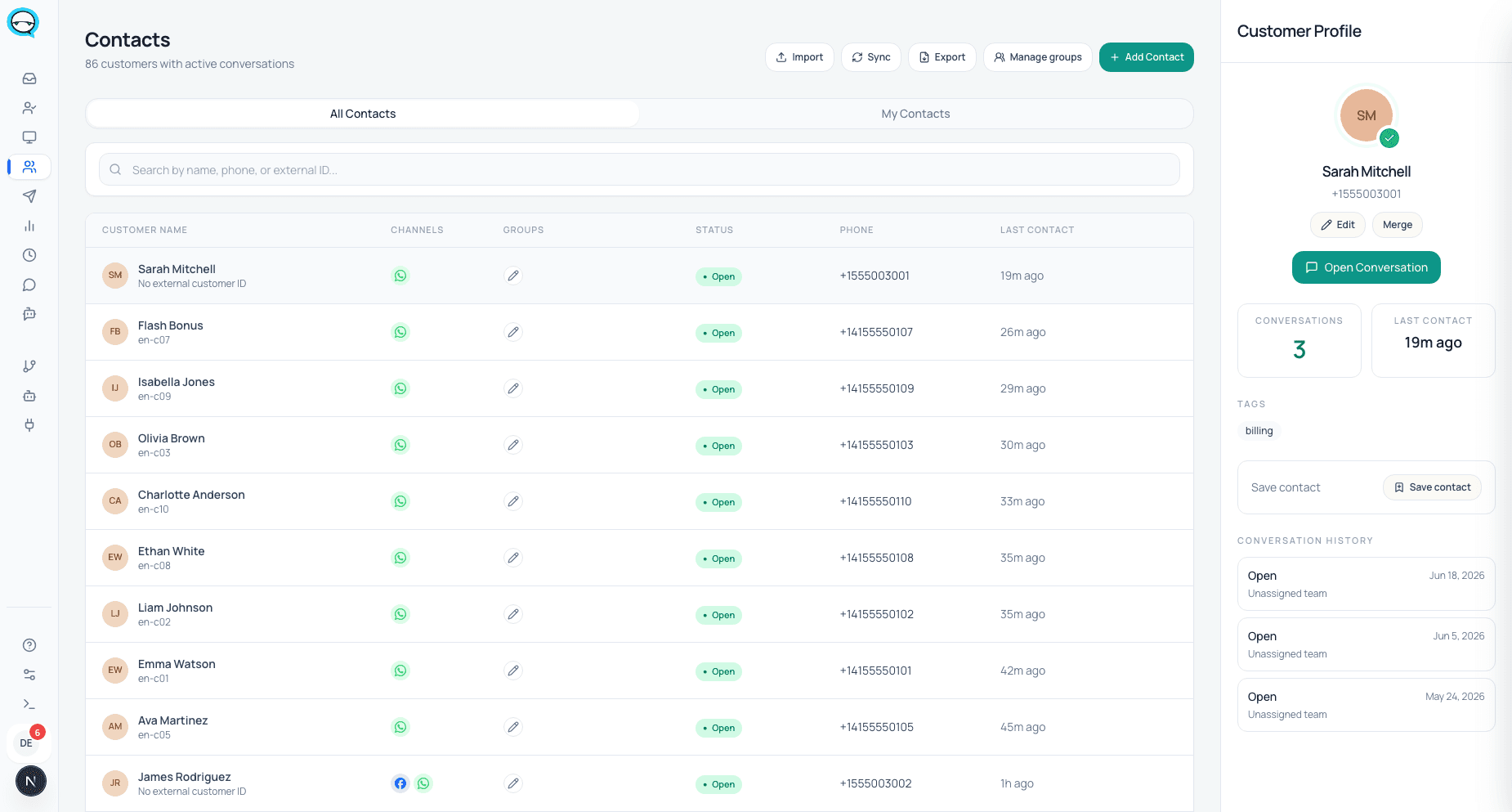
Where the inbox stops and the CRM starts
Teams get into trouble by expecting one of these to be the other. They are different jobs and they should stay that way.
| Concern | The inbox | Your CRM |
|---|---|---|
| The conversation itself | Owns it: messages, notes, ownership, status | Should not hold a copy of every message |
| Who the person is | A contact record with details and conversation history | The system of record for the account and its history |
| Response speed | Measured here, with targets and breach tracking | Not measured here |
| Deal stage and forecast | Not modelled here | Owns it |
| Follow-up commitments | Tasks and appointments tied to the conversation | Owns the longer-horizon pipeline activity |
Which CRMs connect, what data moves and in which direction is covered on the CRM integration page rather than asserted here.
What this does not do
Said plainly, because a sales page is exactly where overclaiming is most tempting.
- ▲We publish no conversion-rate or revenue figure. We have no measured customer outcome we are cleared to share, and a made-up one would be worth less than nothing.
- ▲This is not a CRM. There is no deal stage, no forecast and no pipeline view in the inbox.
- ▲Outside the 24 hour window you cannot improvise a follow-up. If the template does not exist, the follow-up does not happen.
- ▲Marketing templates require opt-in and are charged per delivered message, at a rate that depends on the recipient’s country.
- ▲Before you plan a campaign, check your messaging limit. A new business portfolio caps at 250 unique users, and verification raises that to 2,000.
- ▲From 1 October 2026 Meta charges for non-template messages, so in-window replies to leads stop being free.
Questions from sales leads
Can I message a lead who has gone quiet?+
Only with an approved template once the 24 hour window has closed, and marketing templates additionally require opt-in. Write the templates you will need before you need them.
Can two reps work the same number without colliding?+
Yes. Each conversation carries one owner and the queue shows who it is, which is the mechanism that prevents two reps answering the same lead.
Does this replace our CRM?+
No, and it should not. The inbox owns the conversation and response speed. The CRM owns the account, the deal stage and the forecast.
What happens to the thread when a deal closes?+
Reassign it to whoever owns the customer next. The conversation, its notes and the contact history move with it.
Is replying to leads free?+
Inside the 24 hour window, today, yes. From 1 October 2026 Meta charges for non-template messages, so budget for it before then.
Sources, checked June 2026
Sources
The messaging window, the free entry point window, messaging limits and the dated pricing change are Meta’s. The workflow describes the shipped product.
- Meta for Developers: Pricing on the WhatsApp Business Platform
- Meta for Developers: Upcoming pricing updates for non-template messages
- Meta for Developers: Messaging limits
Checked on 2026-08-03
Who wrote this
marv.Inbox team
Product and support team, marv.Inbox
We build marv.Inbox and we run our own customer conversations inside it, on the same WhatsApp number the buttons on this page open.
See this working on your own use case
Explore the live demo, then book a short walkthrough and we will map your queues, owners, and handoffs together.